
|
Welcome,
Guest
|
TOPIC:
Ilkeston, Derbyshire 12 years 1 week ago #18705
|
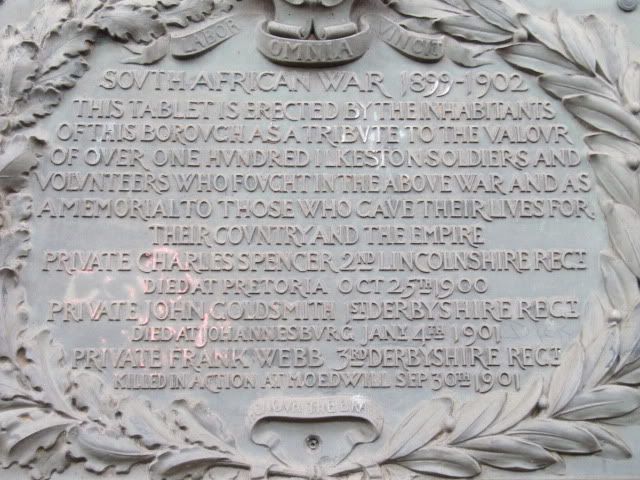
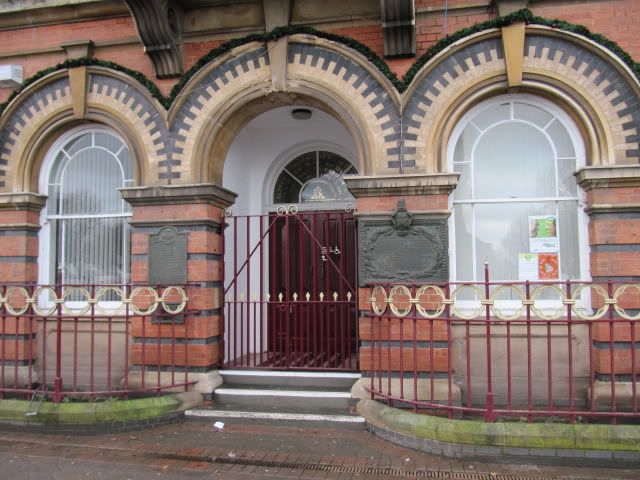
On the outside of Ilkeston Town Hall.
Private Charles Spencer, 2nd Lincolnshire Regiment. Died at Pretoria on 25th October 1900 Private John Goldsmith, 1st Derbyshire Regiment. Died at Johannesburg on 4th January 1901 Private Frank Webb, 3rd Derbyshire Regiment. Killed in action at Moedwill on 30th September 1901 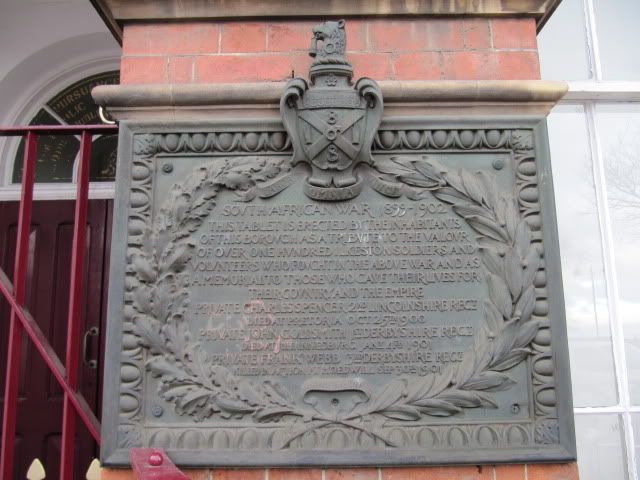
The following user(s) said Thank You: djb, Ians1900
|
|
Please Log in or Create an account to join the conversation. |


Ilkeston, Derbyshire 12 years 1 week ago #18708
|
Excellent pictures, Berenice. Well spotted too. It would be easy to walk past that monument and fail to notice it.
Dr David Biggins
|
|
Please Log in or Create an account to join the conversation. |


Ilkeston, Derbyshire 1 month 2 weeks ago #104403
|
Invitation or ticket for the unveiling ceremony, which was carried out by General French on 3rd June 1903.

Nottinghamshire Weekly Express, 5th June 1903 GENERAL FRENCH AT ILKESTON. UNVEILING OF A MEMORIAL TABLET. A TRIBUTE TO LOCAL YEOMANRY. General Sir John D.P. French, K.C.B., K.C.M.G., visited Ilkeston on Wednesday for the purpose of unveiling a memorial tablet to commemorate the association of Ilkeston soldiers and Volunteers with the late South African war. General French was the guest of Colonel Rolleston (commanding the South Notts Hussars) at Watnall Hall, and in the early afternoon he drove over in an open carriage, escorted by a troop of South Notts Hussars. The day was brilliantly fine, and apparently every inhabitant of Ilkeston had turned out to do honour to the famous cavalry leader, the only commander, according to the historians of the war, who never made a mistake. The streets were gay with bunting, and General French and his equally gallant host were cheered heartily by the living lane of people through which they passed. In the Market Place a guard of honour, formed of the South Notts Hussars, the Ilkeston Volunteers (commanded by Major Walker), the Ilkeston Fire Brigade (under Mr H.J. Kilford), and the local ambulance corps (under Hon. Surgeon Dobson and Superintendent Hubble), awaited the arrival of General French, who was received on behalf of the town by the Mayor (Alderman F. Sudbury). The tablet, which has cost something like £50, was paid for by public shilling subscription, a convenient nucleus being found in a small sum left over from the “Welcome Home” Fund. Messrs Longden and Co., of the Phoenix Foundry, Sheffield, are responsible for the casting of the tablet, which is fixed on the right hand pillar of the principal entrance to the Town Hall. Its width is three feet six inches, and exclusive of the borough arms which surmount it, it is two feet six inches deep. The design is symbolic, the wreath which surrounds the inscription being on one side of oak, and on the other of bay, the symbol of victory. The coat of arms and crest of the borough are appropriately incorporated in the design, along with the borough motto – “Labor Omnia Vincit”. The full inscription reads as follows: “Labor Omnia Vincit.” South African war, 1899-1902. This tablet is erected by the inhabitants of this borough as a tribute to the valour of over one hundred Ilkeston soldiers and volunteers who fought in the above war, and as a memorial to those who gave their lives for King and country. Private Charles Spencer, 2nd Lincolnshire Regiment. Died at Pretoria, October 25th, 1900. Private John Goldsmith, 1st Derbyshire Regiment. Died at Johannesburg, January 4th, 1901. Private Frank Webb, 2nd Derbyshire regiment. Killed in action at Moedwill, September 30th, 1901. “Honour the brave.” THE LUNCHEON. On the arrival of the distinguished party luncheon was served in the Town Hall. The Mayor of Ilkeston (Alderman F. Sudbury, J.P.) presided, and there were also present, besides the guest of the occasion, the Mayoress, Colonel Rolleston and Lady Maud Rolleston, Alderman Murray, J.P., and Mrs Murray, Alderman C. Maltby, J.P., and Mrs Maltby, Mr H.F. Wright, the Vicar of Ilkeston (the Rev. A.M. Evans) and Mrs Evans, Colonel McCleverty, Miss Clayton Cast, Captain Lawson, Major Walker and Mrs Walker, the Town Clerk of Ilkeston (Mr Wright Lissett), …. &c. The Chairman gave the loyal toasts, which were heartily honoured, and then asked the company to honour “The Health of General French”. They were there, he said, to do honour to one of England's greatest generals – (applause) – a general who had taken a very active part in the late war, and who had moved about so quickly that he always kept the enemy on the run. (Laughter and hear, hear). He was dreaded by the Boers. They had all heard of his extraordinary rides amid the African choking dust and fiery sun, and of his habit of turning up where he was least expected by the enemy, and giving them no rest for the soles of their feet. He (the Mayor) would not try to recount to them all the glorious things General French had done in the war, such as the relief of Kimberley – (applause) – and others. He thought he might say that England did not possess a braver general, and that their guest had done his fair share towards bringing the war to a proper end. (Hear, hear). General French had the confidence of his men and the esteem of his country and his King. They were pleased to see him among them, and they considered his presence a great honour, for it was not often they had a real live general at Ilkeston. (Laughter and hear, hear). They were only sorry he had not brought Lady French with him, but they were pleased to see his brother officers and friends. Their best thanks were due to Colonel Rolleston for his influence in getting General French to perform that day’s ceremony. (Hear, hear). He had pleasure in presenting the general with a handsomely-bound volume, “The History of Ilkeston”, which had been written and published by Mr Trueman, one of their townsmen. The toast was received with the greatest cordiality, musical honours and cheers for General and Lady French being given by the assembled company. General French, in responding, thanked them for the kind way in which they had received the toast of his health. He was anxious also to take the opportunity of expressing his deepest gratitude to the inhabitants of Ilkeston for the hearty and generous reception they were kind enough to accord him on his arrival. It was with the greatest possible pleasure that he came there that day, for it must be a pleasure to any loyal subject of the King to visit a part of the country where loyalty and patriotism and love of country were so marked and pronounced as in the counties of Derby and Nottinghamshire. He was not trying to pay them empty compliments or to use a pleasant form of speech in saying this, for there was no part of His Majesty’s dominions which answered the country's call with greater alacrity, or which sent better found and more numerous and valuable detachments to reinforce the army in South Africa than these counties. (Hear, hear). He thought the counties of Nottingham and Derby should be congratulated on the part they had taken in the war. Before the war he had to visit Nottinghamshire two or three times on tours of inspection, and he was therefore in a position to know how earnestly the auxiliary forces of Nottinghamshire – and Derbyshire, too, though he had not then the privilege of visiting that county – were endeavouring to prepare themselves to answer and obey and follow the needs of their country. (Applause). He had not the great fortune to be in very close association with the detachments he had named in South Africa, but he had the great honour and privilege of the intimate acquaintance of two most distinguished Nottingham Yeomanry Cavalry officers. It was under the guidance and training of Colonel Rolleston that the South Notts Hussars attained a degree of efficiency which was unsurpassed among the Yeomanry in the United Kingdom, and it was under the daring and skilful and gallant leadership of that same distinguished officer that they sent the particular squadron of yeomanry which rendered such service in South Africa. He was sure he was only saying what they all felt when he said how delighted they all were that Colonel Rolleston, after being actually left on the field of battle as dead, was there amongst them that day. (Applause). He should also like to convey how deeply the army in South Africa were indebted to Lady Maud Rolleston for her work amongst the sick and wounded in Kimberley. (Hear, hear). The other officer to whom he referred was one whose name would be familiar to most in that room. It was that of Captain Laycock, of the Sherwood Rangers, who distinguished himself greatly in the campaign, carrying important despatches through the enemy's lines, and performing several acts of the greatest gallantry –acts of which he (the speaker) had been a witness. Both the officers mentioned were men of whom Nottinghamshire should be proud. (Hear, hear). In conclusion, the gallant general said there was one thing that all of us in this country should try to remember. The late war taught us many lessons at great cost, but one lesson we had not learnt yet was very important. It was that if we wished to keep this great Empire together, the whole manhood of the country must be prepared to take some share in its defence. It was an old saying that it was difficult to teach old dogs new tricks, and therefore he wanted to urge upon those present the desirability of impressing that lesson upon the youth of the country. Personally, he greatly favoured the introduction of some degree of the military element into the training of every boy, so that he might be prepared to carry out the duty of a subject of this great Empire. (Hear, hear). He thanked the Mayor for the presentation, which was of a suitable and useful kind, and which would serve to remind him of that most interesting occasion. (Applause). THE CEREMONY. The party then proceeded to the platform which had been erected outside the Town Hall, where in the presence of a large and cheering crowd General French unveiled the memorial tablet, after special prayers had been offered by the Vicar of Ilkeston (the Rev. A.M. Evans), and the Mayor had briefly called upon General French to perform the ceremony, referring to him as one who had proved himself, not only a great general, but a true English gentleman. That tablet, he continued, would serve to remind their children's children of a great occasion, and the fact that it had been unveiled by such a famous commander as General French would help to impress on their minds the significance of the memorial. Following the unveiling ceremony, which was performed to the accompaniment of great cheering, the bugles of the Volunteer and Borough Bands played the “Last Post”. General French, in acknowledging the reception, said they had met for the purpose of perpetuating the memory of some of their comrades and friends who fell in the late war in South Africa, and handing down to those who came after them a worthy tribute paid by the inhabitants of that borough to a hundred Ilkeston soldiers, volunteers, and regulars, who took part in it. Numerous detachments from Notts and Derbyshire were represented on that tablet, but time would not permit of reference in detail to the services of all of them. Perhaps the most representative of all was the Notts Hussars, who landed in Cape Town on February 20th, 1900, arrived at Kimberley on March 20th, and shortly afterwards moved, in charge of a convoy, to a place called Boshoff. That was believed to be the first time British yeomanry had ever marched into an enemy’s country. They afterwards took part in Lord Methuen’s action, which resulted in the annihilation of a commando, and were subsequently hotly engaged under the command of that officer, and did excellent service. They afterwards proceeded to the eastern part of the Free State, and on June 1st were engaged in making a vigorous attempt to recapture 500 prisoners taken by De Wet. Though they were not successful in this object, they created considerable consternation in the enemy's ranks, and performed excellent service, though not without serious loss in killed and wounded. Colonel Rolleston himself was among the latter, and was, in fact, left on the field as dead. Time would not allow him to go more into history, but he was sure that if circumstances permitted him to do so, he could mention services of other detachments from Derbyshire and Notts, that would equally excite their pride and admiration. Whenever he looked at these memorials he was always reminded of the custom that prevailed in the French army in the times of the First Napoleon. Whenever the roll of a regiment was called, it was the custom to include the names of the men who had fallen in battle, and the response from his comrades was, “Died on the field of honour!” That was a very nice way of perpetuating the names of heroes, and they in Ilkeston were carrying out the same noble sentiment that day. They were all proud that such memorials should be scattered about throughout the whole of the great Empire to which we belonged. Not only did they keep green the memory of the fallen, but it was a splendid example for others. It acted as an incentive to all of them, whatever their position and station in life, to keep together in the defence of the Empire, and to recognise that this was the most solemn duty of each individual. He thought they ought to do their utmost to instil this sentiment into those who followed after them. Ilkeston has done a great deal towards that by raising such a tablet. It would be there as a memorial of a time when Ilkeston men did their duty, and it was a record and example that might well be followed in the future, as in the past. (Applause and cheering). The gallant General then presented medals to the following ambulance men who had taken part in the war: – Corporals E. Beardsley, S. Burgoyne, J.W. Read, A. Rowland; Privates S. Beniston, T. Hawley, C. Rowland, S. Rowland, T. Sinfield, P. Stanley, and J. Tyson. Mr E. Trueman, C.C., proposed a vote of thanks to General French for the graceful and prominent part he had taken in the ceremony. Hon. Surgeon Dobson, of the St John Ambulance Brigade, seconded, and the compliment was accorded with heartiness. General French spoke a few words of acknowledgement, and subsequently returned to Watnall Hall. The police arrangements were excellently carried out by Superintendent Daybell. ..
The following user(s) said Thank You: EFV, Ians1900, Moranthorse1
|
|
Please Log in or Create an account to join the conversation. |

Moderators: djb
Time to create page: 0.165 seconds
- You are here:
-
ABW home page

-
Forum
-
Medal rolls
-
ABO
-
Surname S
- Schalenburg, August Carl. Burger